# Scott Young - How to Learn Taste (Highlights)
## Highlights
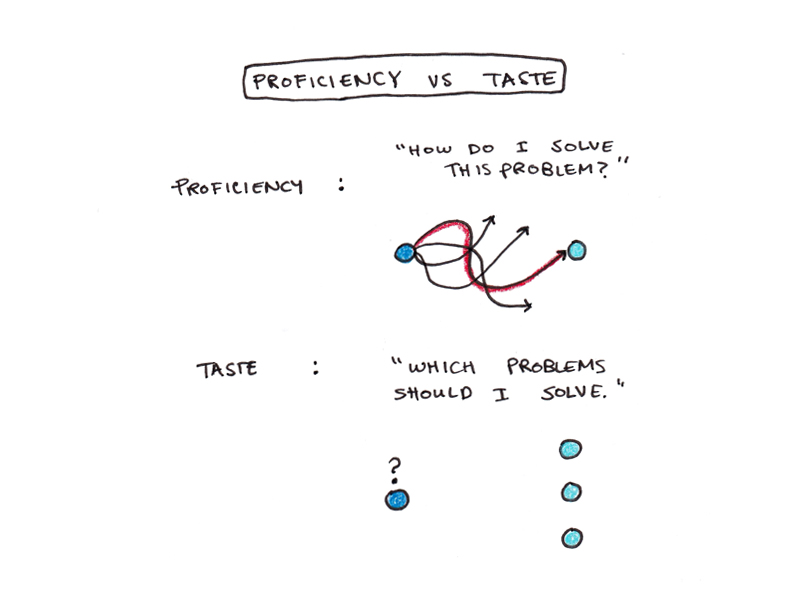
- Taste is the ability to discern good ideas from bad ones, promising opportunities from dead ends, elegant solutions from the merely functional. ([View Highlight](https://read.readwise.io/read/01ke9kb0faxwbgk0g3nh7a2cfr)) ^974575993
- When we have an intuition that something is good, it’s because we’re pattern-matching it to an example of something good we saw in the past. ([View Highlight](https://read.readwise.io/read/01ke9kdfzsq45z0wx5szztdk8q)) ^974576350
- Given intuition is largely memory, this component of expertise requires a lot of exposure to acquire. ([View Highlight](https://read.readwise.io/read/01ke9kf1q3cc5jqcmq6t5rs7gq)) ^974576562
- Taste seems to involve both intuition (quick judgements about the quality of a work or the potential in a given direction), as well as understanding (effortful simulations to anticipate likely design problems and opportunities). ([View Highlight](https://read.readwise.io/read/01ke9kg58pjpeq51ra3nnrqed9)) ^974576629
- Taste, for instance, is largely [tacit](https://en.wikipedia.org/wiki/Tacit_knowledge). The rules that guide it can’t easily be written down. ([View Highlight](https://read.readwise.io/read/01ke9kgs1a7rtfnenhqacn2fk6)) ^974576830
- Art movements, [scientific dynasties](https://www.amazon.ca/Apprentice-Genius-Making-Scientific-Dynasty/dp/0801847575/ref=asc_df_0801847575?mcid=829011291e1f3bbd8269f92dc518c182&tag=googleshopc0c-20&linkCode=df0&hvadid=706764789991&hvpos=&hvnetw=g&hvrand=9816877334080826326&hvpone=&hvptwo=&hvqmt=&hvdev=c&hvdvcmdl=&hvlocint=&hvlocphy=9001542&hvtargid=pla-575084784652&psc=1&hvocijid=9816877334080826326-0801847575-&hvexpln=0&gad_source=1) and [innovation hubs](https://www.amazon.ca/Idea-Factory-Great-American-Innovation/dp/0143122797/ref=asc_df_0143122797/?tag=googleshopc0c-20&linkCode=df0&hvadid=292998652735&hvpos=&hvnetw=g&hvrand=1400293114899363566&hvpone=&hvptwo=&hvqmt=&hvdev=c&hvdvcmdl=&hvlocint=&hvlocphy=9001551&hvtargid=pla-512325728834&psc=1) all seem to point to the idea that much of our taste is acquired through guided observation, rather than direct experience. ([View Highlight](https://read.readwise.io/read/01ke9knm0k7xksbgcxm8y5932q)) ^974577037